
What Lu-Enlilla Understood
A ship is safe at harbor, but that's not what ships were built for. — John Augustus Shedd

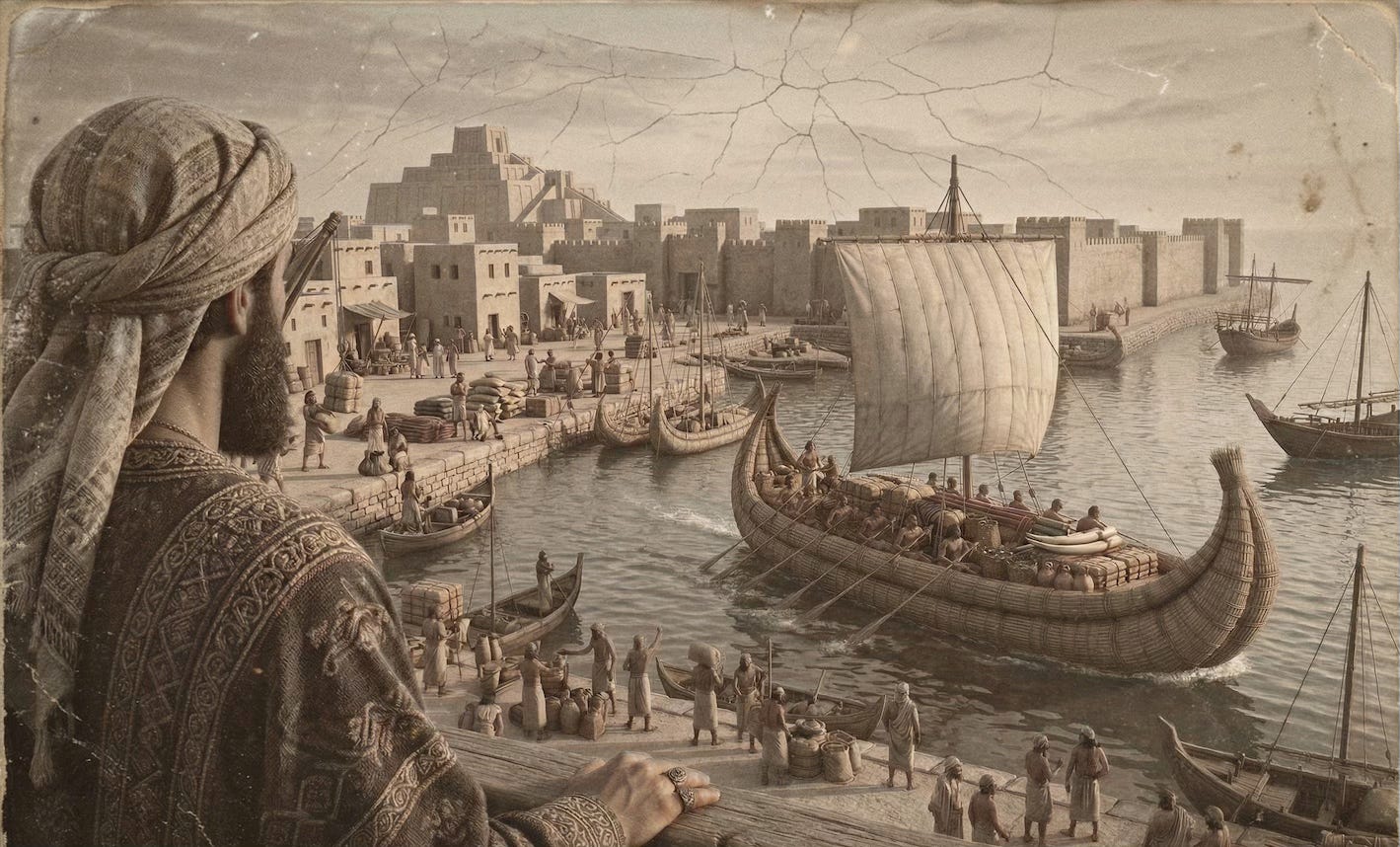
If you close your eyes and concentrate, you can surely see him standing on the edge of the pier, nervously watching as the Má-Magur, a large, high-prowed “deep-sea” cargo vessel, slowly sails away into the Persian Gulf. His name is Lu-Enlilla, and he is a merchant from the Neo-Sumerian city of Ur. It is a cold November morning of 2040 BC. The ship he so nervously watches edge away carries all the capital he has accumulated over his lifetime and his reputation: wool, sesame oil, dried fish, garments and hide.
Why would a keen and wealthy merchant risk his entire fortune on a single voyage? What did he know?
He knew well that the cargo was prized and would be well received in Magan (modern-day Oman). He was fairly certain that his agent, or shamallum (literally “the one who carries the bag”), would represent him fairly and effectively. He was confident of the commercial outcome of his enterprise.
What Lu-Enlilla didn’t know was whether the ship would survive the trek to and from Magan. The relatively shallow waters of the Persian Gulf, the famously violent Shamal winds, or pirates could all spell disaster. So why go all-in on such a risky bet?
Lu-Enlilla had entered into a partnership with the Temple of Nanna in Ur, which functioned similarly to modern-day insurance (or what later became known as a bottomry contract). In essence, these contracts were loan arrangements where shipowners pledged their vessel (the “bottom”) and its cargo as collateral. This allowed them to fund the merchant journey. If the ship was lost at sea, the lender forfeited the loan, and the shipowner was released from his obligation to repay it. In other words, the loan was due only if the ship completed its journey. This, in effect, transferred most of the navigational risk of the voyage from the borrower to the lender.
Same problem, different characters
Lu-Enlilla understood risk was a part of life. He focused his energies, first on survival, then on all else.
For a practical man such as Lu-Enlilla, the broadest definition of risk might have sufficed: “the possibility of suffering damage”. It can be further refined to mean “the possibility of suffering a permanent loss of capital”.
For that definition to work, there are two components, both of which must be present: uncertainty and exposure.
Neither alone is enough to represent risk.
You never really know
Risk means more things can happen than will happen.
— Elroy Dimson
Uncertainty means not knowing what will happen or, worse, not knowing what *can* happen. If you know the outcome of an event, then there is no uncertainty and, therefore, there is no risk.
However, uncertainty, on its own, does not entail risk. There is only risk if the outcome of an event, which is unknown, will affect me. In other words, there must also be exposure.
Can It Hurt Me?
Exposure is pretty straightforward. I may not know the outcome of a particular event, but if none of the possible outcomes can hurt me, either directly or indirectly, then those events do not represent a risk to me.
You’re on a walk and come across a burning house. You don’t know if it will collapse; that’s uncertainty. But you’re a safe distance away, so you don’t care either way — no exposure, no risk. The moment you step inside to check for people, the uncertainty of collapse matters enormously. Now you have both components.
The key point is that you chose to go in. That choice, managing your exposure, is the only thing you ever truly control.
The most we can ever hope to do is try to better understand uncertainty and to manage exposure. Humility will keep you out of burning houses.
Your success depends on the risks you take. Your survival depends on the risks you avoid.
— James Clear
Finance professors are wrong
Financial academia will tell you that risk is measurable and that it’s called volatility. Calling risk volatility is just a lazy attempt to simplify the complex into something easy to quantify, so they can fit it neatly into their models. They use variance, standard deviation or beta as if that really provided useful information. It’ll just make you think you know something, but you won’t.
Lu-Enlilla understood it better: he wasn’t too worried about the price his merchandise would fetch in Magan. He was worried if his merchandise would get to the market. Volatility is not risk; it is the reason buying opportunities exist and is what makes investing worth doing.
Volatility is a risk only in the sense that a sharp drawdown in your holdings will mess with your head, strain your emotions and test your convictions. Volatility *can* make you sell at the wrong time and for the wrong reasons, turning a paper loss into an actual, permanent loss.
Risk is buying the wrong stock by ignoring contradictory evidence, or acquiring more exposure than you can handle by using leverage. Risk is actually believing that your Excel model reflects reality or viewing markets through a dogmatic lens. These are risks that can hurt you enough to kick you out of the game entirely, and academia is hopeless at putting them into equations, so it ignores them.
Markets, and life more broadly, don’t care about models.
What You Can Actually Control
You can’t eliminate uncertainty; you can understand it. You can manage exposure. That’s the whole game.
Lu-Enlilla could not forecast the weather and could not even guess as to the result of the voyage. He could have chosen not to participate, but instead, he decided to find a way to make the trip happen without risking ruin. He only kept commercial risk, the part he understood best. He transferred to others the risk of the high seas. All he needed was to manage his exposure.
Today, the means, the instruments, the rules and the names are different, but the essence of the game is unchanged. We can research our investments, make an educated and reasonable estimate of the possible outcomes, and then manage our exposure through position sizing and the use (or lack thereof) of leverage.
Investors will always have a blind spot. We don’t know what we don’t know; if overconfidence is our greatest threat, humility is the antidote.
Back at the Dock
Back at Ur in 2040 BC, Lu-Enlilla sends the ship and walks home. He’s done everything he can; he managed his exposure as well as his tools allowed. The rest is uncertainty, which is to say, the rest is just life.